top of page

[JEC WORLD 2026] FRT Robotics Unveils Muscle-Assist Wearable Robot Technology

As demand grows for technology that reduces physical strain from repetitive and heavy-load work at industrial sites, exoskeleton-type wearable robot technology is expanding its range of application across manufacturing and logistics. Muscle-assist equipment that supports worker movement is drawing particular attention, with adoption under review for its contribution to work continuity and safety.
This trend was evident at JEC World 2026 in France. Held over three days from March 10 to 12, 2026 at the Paris-Nord Villepinte Exhibition Centre, the event showcased composite material technologies — carbon fiber, glass fiber, nano materials, resin, and polyester — alongside a wide range of industrial applications.
The Korea Pavilion was jointly operated by the Korea Carbon Industry Promotion Agency, the World Korean Economic & Trade Association, and the Korea Carbon Nano Industry Association.
Among the exhibitors, FRT Robotics participated with a focus on muscle-assist wearable robots and composite-material-based structural design.
Muscle-Assist Wearable Robots: Designed Around Worker Support
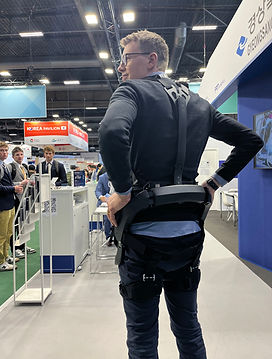
FRT Robotics develops muscle-assist wearable robots — exoskeleton-type equipment — that reduce physical strain on workers at industrial sites. Rather than replacing the worker, the equipment focuses on distributing physical load during work and improving fatigue during repetitive tasks.
Manager Park Jeong-eun explained, "A wearable robot is not a concept that replaces the worker. It is assistive equipment designed to reduce physical burden and improve work continuity."
Passive-Structure 'StepUp NEO' Series
The exhibition introduced the industrial wearable robot product line, the 'StepUp NEO Series.'
The product applies a passive muscle-assist structure, distributing load on the lower back and upper body through a mechanical structure without a separate battery or drive motor. The design addresses fatigue reduction and lower-back injury prevention in work environments involving repetitive lifting or extended use of the lower back.
Lightweight, Slim Exoskeleton Built on Carbon Composites
FRT Robotics applies carbon-fiber-based composite materials in its wearable robot design.
Using composites, the company achieves weight reduction while maintaining structural rigidity, and adopts a slim-fit exoskeleton form suited to extended-wear environments. A modular structure also allows equipment configuration to be adjusted to the work environment.
Manager Park said, "Because this is equipment premised on long wearing times, securing both light weight and wearing comfort is critical," adding, "We apply designs that address structural stability and wearability together through composite materials."
Technology Scouting and Partnership Opportunities at a Composites Exhibition
Through this exhibition, FRT Robotics reviewed composite material technology trends and explored material technologies applicable to next-generation wearable robot development.
JEC World is a materials-focused global exhibition where companies across industries share technologies and application cases. During the exhibition, the company held technical exchanges with composite material firms and discussed potential collaboration.
Manager Park said, "Through direct exchange with composite material companies, we identified material technologies applicable to lightweight structural design," adding, "We are reviewing directions for combining wearable robots with material technology."
Expanding into the European Market and Building Partner Networks
FRT Robotics plans to use the exhibition as a basis for expanding its foundation for entry into the European market.
Building on the global network established at the exhibition, the company intends to form partnerships with composite material firms and continue developing wearable robots based on lightweight structures. It will also review applicability by industry and pursue pilot customer development and collaborative projects.
Advancing Technology Through Human Data
Over the longer term, the company is preparing functional advancement using digital twin technology based on human data collected at industrial sites. The direction is to predict user status from movement data gathered during wearable robot use, and to implement assistive motions suited to the work environment. To support this, the company plans to establish data collection and refinement systems alongside security policies.
Manager Park Jeong-eun said, "We are developing technology in the direction of refining assistive functions based on user movement data," adding, "We are pursuing data-driven technology advancement with field applicability in mind."
Post-Exhibition Execution Plans
FRT Robotics will hold follow-up meetings with composite material companies contacted at the exhibition and work to formalize collaboration. In parallel, the company will select target industries and customer groups for European market entry and establish a phased execution plan.
The company also plans to pursue joint development projects for lightweight next-generation wearable robots alongside data-driven technology development for industrial sites. By combining composite-material-based lightweight structural technology with muscle-assist wearable robot technology, FRT Robotics is expanding applicability across industrial environments.
Manager Park said, "We continue to develop wearable robots that address both lightweight structure and wearing stability," adding, "Through integration with composite material technology, we plan to expand technologies applicable across diverse industrial environments."

bottom of page